Every TechOps leader reading this will be told, repeatedly, over the next eighteen months, that AI is about to change how they run their department. Most of what they will be sold is an assistant or chatbot bolted onto processes, systems, and data that were already struggling under the weight of legacy tooling, manual entry, and disparate data sources.
This piece is about what we think AI actually changes in repair management, and what has to be built before any of it can work. Success in this arena goes well beyond better reporting: it is about turning data visibility and hard-won expert knowledge into systems that directly reduce cost, improve turnaround times, and lift supplier performance.
The problem
Aviation repair management runs on a unique mix of deep engineering discipline and analogue processes. The processes exist scattered across ERPs, email folders, spreadsheets, and scanned PDFs. The engineering discipline sits in the tacit knowledge of a handful of experts in each department leveraging years of experience to effectively handle the myriad of edge cases they see each day.
The raw data and knowledge sets are there. The information systems are not.
Our summary of the problem is this: Operators are being failed from two directions at once.
Below them sit the incumbent systems: built on legacy architectures that were never designed to support AI or serious analytics, digitizing retrospective processes instead of enabling live workflows, and often creating more administrative work than they remove. They onboard data without validating it, enriching it, or taking any ownership of it. They miss the decision data entirely. And they move on development cycles too slow to fix any of this.
Above them sit the new AI vendors, selling intelligence with no foundation underneath it. This is why so many of them struggle to show a return. An assistant on top of broken foundations can boost productivity, but it will rarely generate real savings, and once the licenses and tokens are counted - the department is often spending more than it did before. That is not bad faith on anyone's part. It is what happens, structurally, when the foundations get skipped.
The overarching problem is simple. AI does not act well on partial, fragmented information. It needs a coherent data model, and it needs the whole picture in its full richness. You cannot point a model at a shared inbox and a fleet of incomplete ERP tables stitched together by decades of workarounds and expect anything useful and reliable at scale. The AI will summarize. It will draft. It will make the job feel lighter for a week. Then it will plateau, it will make mistakes and the user will lose confidence, because the decisions it was supposed to learn from were never captured in a form it can learn from, and because it never had the full picture as input.
The common analogy for AI and its transformation is the internet boom, but in reality, electrification actually offers the clearest precedent for what is happening now. Factories in the 1880s ripped out their steam engines and dropped in electric motors, expecting an immediate productivity gain. For decades, they got almost nothing, because the factory itself, the layout, the shafts and belts, the workflow, was still built around a steam engine. The real gains only came once factories were redesigned from the ground up: single-story layouts, individual motors per machine, work organized around the process rather than the power source.
AI in repair management is now arriving in the same pattern. Bolting a model onto the same fragmented ERPs, inboxes, and spreadsheets is the equivalent of swapping in the motor and leaving the shafts and belts in place. What is required is a redesign of the factory, but this is not an option for such large companies with legacy data and technology stacks.
Our solution, the ladder
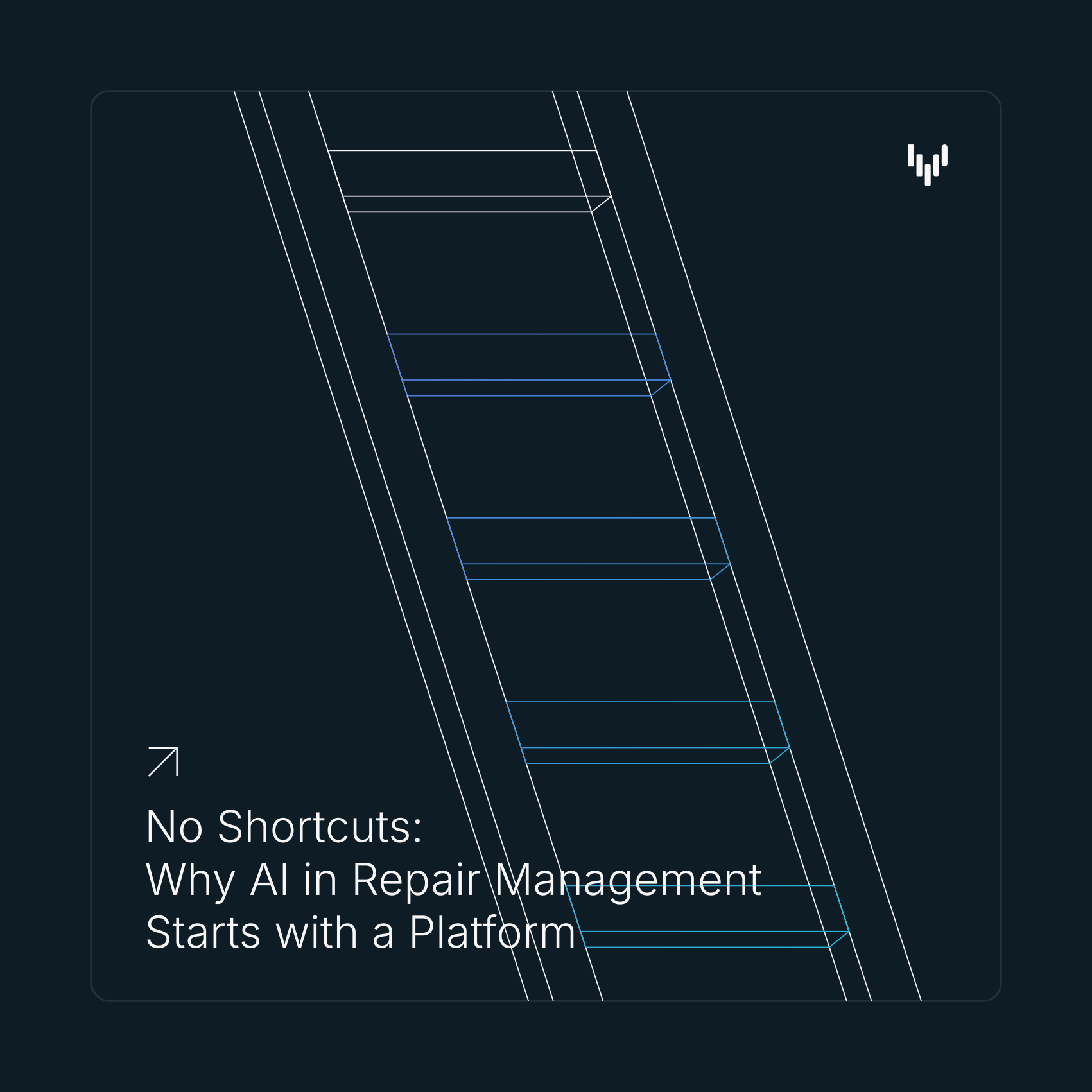
So how do you build information systems that enable AI to genuinely deliver? At ValStream we think about it as five layers. The layers have to be stepped through in sequence, like rungs on a ladder. There are no shortcuts.
- The first rung is a single source of truth. Data unified across ERPs, documents, supplier correspondence, emails, market data, industry master data, and the everyday artifacts of repair work. Much of this data has to be created before it can be analyzed, reconstructed from quotes, teardown reports, and invoices that today exist only as PDFs, excels and email attachments.
- The second rung is an intelligence layer. The single source of truth data is enriched, linked, standardized, and interpreted into meaningful signal, all deployed in a common semantic layer on a technical stack that lets the latest technologies actually interrogate and make use of it.
- The third rung is a decision layer. Real human choices and negotiations happen inside the system, rather than alongside it in the digital dark. Supplier updates, quote challenges, and negotiation outcomes are recorded as they happen, so the system gathers more context every day. This only works in practise if the software saves people time and delights them through genuinely great user experiences. A system that creates cumbersome new work for people who are already stretched will simply not be used, and a system nobody uses captures nothing.
- The fourth rung is a prescriptive layer. With the first three layers in place and improving, the system starts recommending what should happen next. Negotiate this quote with this information. Chase this overdue order. Change this schedule and tweak this workscope. Experts confirm or reject the suggestions, and every response makes the next one better. They are also directed to the day's most important decisions from the moment they log in. Expert human attention is likely to be the scarcest resource in your department over the next five years, as AI becomes ever more powerful and commoditised. This layer makes sure it's spent where it matters.
- The fifth rung is the agentic layer, and it is only made possible by success on every rung before it. The system now holds the full picture and has developed real world intelligence around what makes a good decision. It stops behaving like a tool and starts behaving like a teammate: doing the work, showing its reasoning, and bringing decisions to your experts only where compliance demands it or judgment genuinely matters.
Most AI sold into heavy industry today attempts to skip to rung five solutions while missing the data and real-world wisdom that needed to be earned first. It is an attempt to build and use a ladder with only the top rung.
This is not to say that this is an “all or nothing” game; it pays as you climb. There is significant value at every stage. Unified data enables new valuable analytics and reporting. An intelligence layer with business logic is enough to see where you’ve been bleeding and focus your resources. Decision capture compounds into sharper negotiation. Prescriptions and automation remove work rather than merely accelerating it. This is a reward-based climb, not a pot of gold at the end of a rainbow.
The questions worth asking
Over the next eighteen months, the question to put to every vendor is not whether they have AI. Everyone has AI now. The questions that separate the serious from the rest are these.
- What platform does the AI sit on?
- What data foundation is that platform built from: your transactional records alone, or the deeper document and decision data this era actually demands?
- What data and intelligence are you creating for me that I do not already have?
And most importantly, where and how do the savings land? Are you creating paper savings in human productivity? How will you measure the effect on the P&L? Will you take responsibility for these outcomes?
Ask these questions and the field thins out quickly.
There is, of course, an obvious follow-up once you accept all this. If the foundations are where the value is, why not build them yourself? It is the right question for any capable organization to ask, and it deserves an honest answer. We have written our answer as a companion to this piece, coming next week: ‘Why ValStream: The Build or Buy Dilemma.’